
Today’s post is 875 words, 22 photos, a 4 minute read. Enjoy
Hi everyone,
While I’m away on travel gathering more stories and photos, I’m reposting articles from the archives. This week I’ll take you back to our two-month adventure to the Southwest of the United States. There is so much to see and do in those wide open spaces. But some places we visited like Chiricahua National Monument are are deeply etched in our memories. Come along for a look at what we saw.
Chiricahua National Monument
After spending a few weeks in Texas and New Mexico, we crossed the border into Arizona, nicknamed the Grand Canyon State or the Copper State, take your pick. Our first stop was a three-day stay in Willcox, just off I-10 about 50 miles west of the Arizona/New Mexico state line. We had a couple of purposes for stopping here. One was to visit the Chiricahua National Monument and the Fort Bowie National Historic Site but also to check out the area that was home to the Son-in-Law for five years. He taught vocational agricultural at Willcox High School (home of the Cowboys!) and we’d heard a lot about Willcox over the years.
We arrived the day before the lunar eclipse so the full moon was huge and bright. Here a couple of photos of the sunset and the super moon taken from the campground.


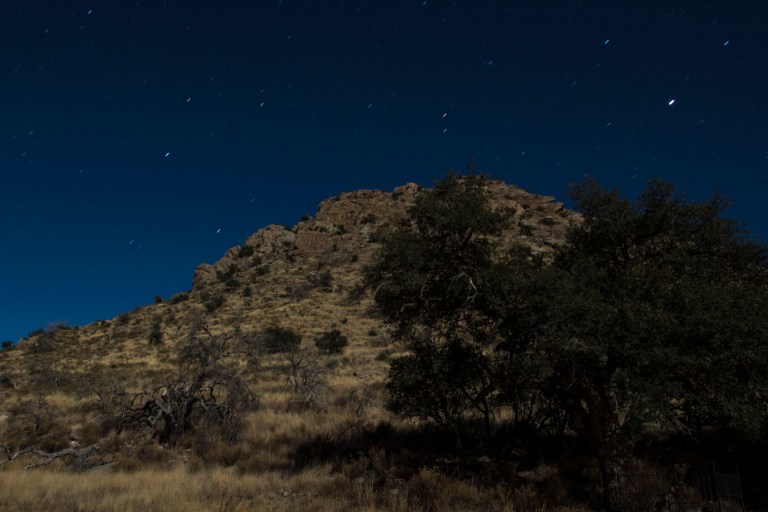
The next morning, I roused my traveling partner at 3 AM to make the 35 mile drive to the Chiricahua National Monument to watch the lunar eclipse that was scheduled to begin around 4:30 AM. We arrived at the parking lot at about 4 AM and had to wait a least a half hour before the eclipse began, we could have slept in for another half hour or so and maybe even had some breakfast. But alas, we were ready and weren’t disappointed, it was very awesome to watch. I did try some night photography that I don’t do much of but here are some of my attempts.

After enjoying the eclipse followed by a cat nap in the truck, we headed into the Monument at daybreak. Fortunately, the visitor center opens at 8:30 AM so we could get our National Park Passport stamps and check out the exhibits before seeing the park. First, a little about Chiricahua, it was established as a National Monument in 1924 to protect the many hoodoos, pinnacles, spires and balanced rocks.

The Monument covers over 12,000 acres and receives just over 50,000 visitors per year. Popular activities include hiking, camping, trail riding on horses, camping and just plain gawking at the magnificent rock formations. The nearby Chiricahua Mountains is where four distinct biological regions meet: the Sonoran and Chihuahuan deserts and the Rocky Mountain and Sierra Madre ranges. This convergence brings with it a diversity of plant and animal species including 170 types of birds so a lot of birdwatchers are attracted to this area. In fact, Chiricahua is derived from a native tribe’s word meaning “range of the wild turkey.” About fifteen years ago, the Gould’s wild turkey was successfully reintroduced into it’s original habitat in the Chiricahua area.
From the Visitor Center, it’s an eight-mile scenic drive through Bonita Canyon to Massai Point that puts you on top of the world. Here’s what you’ll see during the trip.


The following photos depict what beauty greets visitors upon arriving at Massai Point, the land of standing up rocks. Whenever I see these kinds of rock formations I find them very fascinating and I realize how little I remember from science classes in grade and high school (other than it was a long time ago!). Then I look at the explanations and after a few paragraphs my head wants to explode with too many details, if only someone could turn those dry, complex, scientific explanations into an interesting, compelling story. Maybe I would understand and stick with it for more than a few minutes!


We took a couple of short hikes on the many trails that depart from this location. We made our way back towards the Monument exit in a leisurely fashion, stopping to enjoy the many interesting formations nature created for us to view. Before exiting, we made a stop at the Faraway Ranch now a historic district within the Monument. Begun as a working ranch, it was turned into a guest ranch just prior to the designation of Chiricahua as a national monument. This ranch hosted guests and provided trail rides up until 1973 when it was turned over to the National Park Service for preservation. Here are a few photos from our visit to the Faraway Ranch.


Whenever anyone asks what our favorite parts of our trip to the Southwest were, we often mention Chiricahua National Monument. It is one of the more unique and definitely one of the quietest, most serene places we visited. It’s also trying to achieve official designation as a Dark Night Sky park. We like a lot of sites we saw during our travels but this is one of the best and one of the most memorable.
Next week, I’ll be back in ordinary time with new photos and stories from our travels to Italy and Ghana. See you then.
Until next week, happy travels!
Tom
PS: If you missed last week’s post on Beautiful Ghana, click here.